

Custom Branded Coffee for Events: Your How-To Guide
Table of Contents
- What You'll Need Before You Order
- Step 1: Define Your Event Goals and Branded Coffee Budget
- Step 2: Choose Your Coffee, Roast, and Custom Label Design
- Step 3: Plan Your Coffee Cart Setup and Logistics
- Step 4: Order Personalized Coffee Bags for Wedding Favors and Client Gifts
- Step 5: Build Corporate Coffee Gifting Strategies That Scale
- Common Mistakes to Avoid with Branded Coffee for Events
- Frequently Asked Questions
Last Updated: September 14, 2026
What You'll Need Before You Order
Custom branded coffee for events starts with a short list of decisions, not a shopping cart. Gather these details first: your guest count, your event date, whether you want a live coffee station or packaged bags, and your label artwork in a print-ready file. MineYourBusinessCoffee roasts every order to date, so the more lead time you build in, the fresher your coffee lands.
Here's your pre-order checklist:
- Final guest or recipient count, plus 10% buffer
- Event date and delivery address
- Logo file in vector format (SVG, EPS, or PDF)
- Choice of whole bean, ground, or single-serve
- Label copy: names, dates, or a short message
- Budget ceiling per guest
Most planners underestimate one thing: label proofing takes longer than the coffee itself. Get your artwork approved early and the rest of the timeline compresses nicely. If you're ordering personalized coffee bags for wedding favors alongside an event order, combine them into one shipment to simplify logistics and cut freight costs.
Step 1: Define Your Event Goals and Branded Coffee Budget
Your budget should follow your goal, not the other way around. A trade show booth needs volume and speed. A client appreciation box needs fewer units and better presentation. Those two goals produce very different orders.
Work backward from the outcome:
| Event Goal | Order Format | Priority |
|---|---|---|
| Lead generation at a booth | Live cart, high volume | Speed of service |
| Client appreciation | Gift bags or boxes | Presentation quality |
| Wedding favors | Personalized bags | Label personalization |
| Internal team morale | Bulk bags, office pantry | Cost per unit |
A common mistake is ordering premium packaging for a high-traffic booth where guests grab and go. Spend on the coffee and the label, not the box, when volume matters. For intimate gifting, the reverse is true.
Set a per-guest ceiling before you request quotes. It keeps every later decision, from roast to packaging, anchored to a number you can defend to a finance team.
Step 2: Choose Your Coffee, Roast, and Custom Label Design
Coffee selection drives more of the guest experience than the label does. Pick the roast first, then design around it. A medium roast suits the widest range of palates at a mixed event; a dark roast reads as bolder and pairs well with dessert service.
For custom coffee label design tips, keep three rules in mind:

- Keep the logo under 40% of the label area so the text stays legible
- Use one accent color, not four
- Put the essential info (name, date, roast) in the top third where eyes land first
The label is your brand presence on every cup and bag that leaves the venue. Guests photograph good labels. That's free event marketing, and it's the main reason branded coffee outperforms a plain urn of drip.
MineYourBusinessCoffee builds labels from your story. You send a concept, an old photograph, or a rough sketch, and the team turns it into a finished design. That turnaround matters when your event is three weeks out and your designer just went on vacation.
Step 3: Plan Your Coffee Cart Setup and Logistics
Space and power decide your setup more than aesthetics do. Most ranking pages show a pretty cart photo and stop there. This section gives you the technical checklist event planners actually need before signing a venue contract.
Measure your footprint before you book a cart. A full-service espresso bar typically needs roughly 8 to 10 linear feet of counter or floor space, plus a 3-foot clearance behind the barista and a 4-foot guest approach zone in front. A self-serve drip station with airpots and a condiment table can fit in as little as 4 linear feet. A packaged-bag gifting table needs almost nothing, a 6-foot table and a back-of-house staging area.
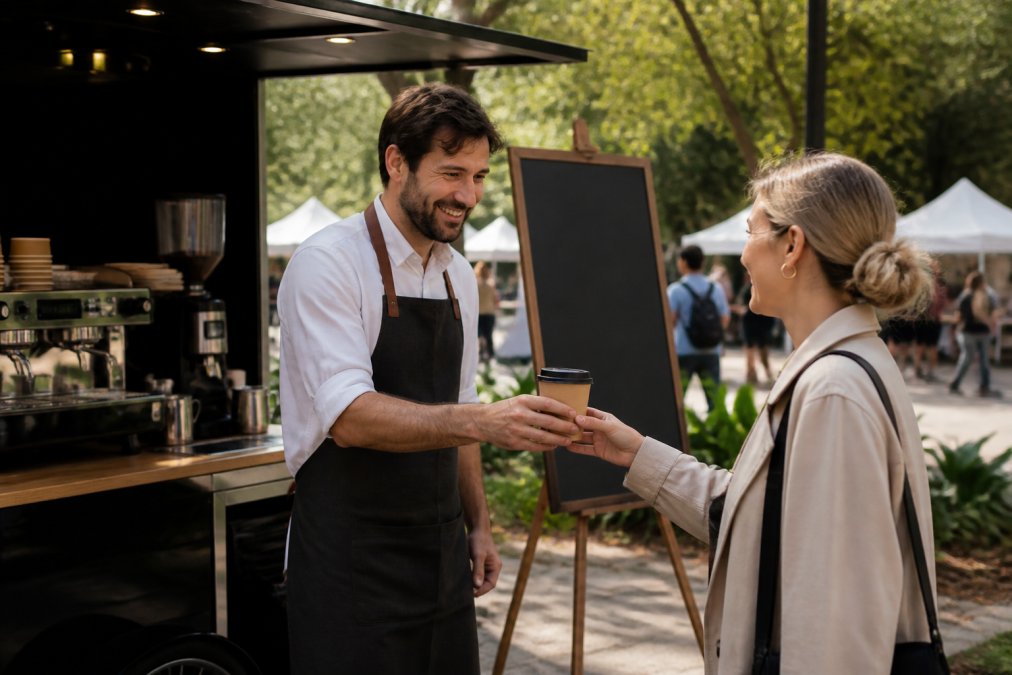
Coffee catering logistics break down into five moving parts. Walk through each one with the venue coordinator before you sign:
- Power: A commercial single-group espresso machine draws roughly 15 to 20 amps on a dedicated 120V circuit (osha.gov). Ask the venue for the outlet location, amperage, and whether the circuit is shared with lighting or AV. Shared circuits trip breakers mid-service. If dedicated power isn't available, a cart with a built-in generator or a propane-heated boiler is the fallback, but many venues restrict propane indoors, so confirm before you commit.
- Water: Espresso machines need a plumbed line or a refillable reservoir. A 5-gallon reservoir supports roughly 100 to 150 drinks before a refill. Ask where the nearest utility sink or water source is and how far the cart will be from it. A 50-foot hose run is workable; a 200-foot run is not.
- Footprint and flow: Position the cart where guests naturally queue, near the entrance, next to the bar, or at the end of a buffet line. A dead corner kills throughput no matter how good the coffee is. Leave a clear path for guests to exit the line with a hot cup in hand.
- Staffing: One skilled barista handles roughly 60 to 80 drinks per hour on a full espresso menu. Drip or batch-brew service runs 150 to 200 cups per hour with one attendant. For a 300-guest reception with a two-hour coffee window, plan on two baristas minimum.
- Load-in and load-out: Ask about dock access, elevator size, freight hours, and strike time. A cart that can't fit in the service elevator becomes a hand-carry problem, and hand-carrying a 200-pound espresso machine up three flights is a line item nobody budgets for.
The venue contract is where this gets won or lost. Many venues restrict open flames, require a certificate of insurance naming the venue as additional insured, and cap load-in windows to specific hours. Ask about all three before you sign anything.
For a mobile espresso bar, arrival time matters as much as setup. Build in a 60-minute buffer before doors open for setup, plus 30 minutes for a test shot and temperature calibration. If the cart is late, guests notice immediately, and no label design recovers that first impression.
For official guidance on food service at public events, check your local health department's food safety guidance for temporary events before finalizing your cart setup.
Step 4: Order Personalized Coffee Bags for Wedding Favors and Client Gifts
Personalized coffee bags for wedding favors work because they get used, not shelved. A couple's names and wedding date on a bag of fresh-roasted coffee becomes part of the morning routine long after the reception ends.
For weddings, order one bag per couple or per household rather than per guest. It cuts waste and keeps the per-unit budget reasonable. A short message on the label, the date and a thank-you line, does more than an elaborate design.
For client gifts, the calculus shifts. A bag that arrives stale or generic damages the relationship more than sending nothing. Freshness is the whole point. MineYourBusinessCoffee roasts to order so the bag ships close to its roast date, which is exactly what you want when the recipient is a client you're trying to impress.
Step 5: Build Corporate Coffee Gifting Strategies That Scale
Corporate coffee gifting strategies fail when they're treated as one-off purchases. The businesses that get real value from branded coffee build a repeatable system: a standard label template, a fixed roast, and a quarterly or monthly cadence tied to onboarding, anniversaries, or client milestones. But a system only earns its budget if you can measure what it returns, and that's where most programs fall apart.
Measure the program like a marketing channel, not a nice gesture. No ranking page covers this, so here's the framework. Track four numbers per send: cost per recipient, response rate (replies, thank-you notes, meeting requests), pipeline influence (deals that cited the gift in a touchpoint), and retention lift (renewal or repeat-purchase rate for gifted accounts versus a control group). A common pattern is that a $15 to $25 per-recipient coffee gift generates a higher response rate than a $75 branded swag item because it gets consumed and remembered instead of shelved. You don't need a data team, a simple spreadsheet with one row per recipient and those four columns is enough to see which formats earn their budget.
Match the format to the budget tier. Scaling changes what you optimize for:
- One-time gift: best presentation, highest per-unit cost, best for high-value prospects or executive thank-yous
- Quarterly client touch: consistent roast, moderate cost, recurring label, best for mid-tier accounts you want to stay top-of-mind
- Office supply: bulk bags, minimal packaging, cost per unit rules, best for internal morale and pantry programs
For a 40-person office running monthly deliveries, consistency beats novelty. Pick one roast your team likes and keep the label stable so the shipment reads as a routine, not a surprise. A loyalty program helps here: MineYourBusinessCoffee's Founders Club gives members a lifetime discount and free shipping, which changes the math on recurring orders.
Build sustainability into the branding, not on top of it. This is the second gap no ranking page covers. Corporate ESG goals increasingly require that branded materials be compostable or recyclable, and coffee gifting is an easy place to comply.
The mistake most often seen is businesses treating coffee gifting as a marketing expense and then never measuring it. Track it like any other touchpoint. Note which clients respond, which events drive follow-up conversations, and which formats get photographed and shared. That feedback loop is what turns a nice gesture into a working part of your client relations.
Common Mistakes to Avoid with Branded Coffee for Events
The single biggest mistake is ordering too late. Custom labels, proofing, and roasting all take time, and a rush order rarely produces the quality you want. Give yourself at least three to four weeks for a custom run.
Here are the others worth watching:
- Skipping the sample: you approve a label you've never seen printed
- Ignoring the venue's rules: power, insurance, and load-in limits derail setups
- Over-designing the label: too many colors, unreadable at arm's length
- Ordering perishables too early: freshness is the product, don't waste it
- Forgetting the buffer: running out of bags with guests still in line
Each of these is avoidable with a checklist and a calendar. The pattern behind all of them is the same: treating branded coffee as a last-minute add-on instead of a planned part of the event.
For official guidance on food service at public events, check your local health department's food safety guidance for temporary events before finalizing your cart setup.
Custom branded coffee for events rewards planning more than spending. Nail the roast, the label, and the logistics, and you get a gift or a station that guests actually remember. MineYourBusinessCoffee roasts every order fresh and builds custom labels from your own story, so your event coffee carries your brand instead of a generic one. With made-to-order roasting, a full range of single origins, blends, and teas, and the Founders Club discount for repeat orders, it's built for both one-time events and ongoing client gifting. Get started with MineYourBusinessCoffee and turn your next event into a coffee moment people talk about.
Frequently Asked Questions
How do you incorporate custom branding into event coffee service?
You can brand nearly every touchpoint: custom labels on coffee bags, logo latte art or printed drink toppers, personalized coffee sleeves, and a custom menu board. For a full-service bar, pair an on-site barista with branded cups and signage. For favors, order personalized coffee bags with your logo or event date. MineYourBusinessCoffee lets you build your own coffee label in about 15 minutes, so even small events get a polished, branded look without a design agency.
How far in advance should I order custom labeled coffee for an event?
For custom labeled coffee, plan on two to three weeks before your event date. That window covers label design approval, roasting, and shipping. If your event is sooner, ask about rush options. For large orders of 200 or more bags, add a buffer week. Ordering early also lets you request samples to verify flavor and label print quality before committing to the full run.
Can I customize the coffee roast for my corporate event?
Yes. You can pick from single origins, blends, flavored coffees, and teas to match your event's tone. A light roast suits morning networking, while a dark roast or flavored option works for evening receptions. If you are unsure, request a sampler. MineYourBusinessCoffee roasts to order, so your beans arrive fresh rather than sitting on a shelf, which matters when guests judge your brand by the first sip.
What makes a good branded coffee gift for conference attendees?
A good branded coffee gift is useful, portable, and personal. A 4-ounce or 8-ounce bag of fresh-roasted coffee with a custom label hits all three: attendees take it home, use it, and see your logo every morning. Add a handwritten-style note or a QR code linking to a landing page to extend the brand touch. Keep packaging compact so it fits in a carry-on or tote bag without becoming a burden.