

Best Coffee Beans for Home Office: 2026 Picks
Table of Contents
- Quick Comparison: Best Coffee Beans for Home Office
- Benefits of Fresh-Roasted Coffee Beans for Remote Work
- Best Coffee Brewing Methods for Home Office Setups
- How to Store Coffee Beans for Freshness in Your Home Office
- Top Picks: Best Coffee Beans for Home Office by Roast and Use Case
- Subscription vs. One-Time Purchase for Home Office Coffee
- Equipment Pairing: Match Beans to Your Home Office Brewer
- Frequently Asked Questions
Last Updated: September 11, 2026
Quick Comparison: Best Coffee Beans for Home Office
Finding the best coffee beans for home office setups comes down to three things: freshness, roast level, and how you brew. This guide from MineYourBusinessCoffee breaks down what actually matters when you're pulling shots or brewing drip between meetings.
Most office coffee sits in a warehouse for months before it reaches your mug. Fresh-roasted beans, by contrast, hit their peak flavor within days of roasting and hold it for a few weeks when stored properly (peer-reviewed research). That gap explains why the same bean can taste flat at one desk and vibrant at another.
Below, we'll show you exactly how to match beans to your brewer, store them so they stay fresh, and decide whether a subscription or a one-time order fits your routine.
Option |
Price |
Best For |
Format |
|---|---|---|---|
$24.99 |
Testing roasts before committing |
6 x 2 oz packs |
|
$24.99 |
Exploring origin flavor notes |
6 x 2 oz packs |
|
Flavored Coffees Sample Pack |
$24.99 |
Variety and afternoon cups |
6 x 2 oz packs |
Best Seller Bundle |
$61.99 |
Consistent daily supply |
3 x 12 oz whole bean |
Coffee Maker Cleaner Tablets |
$19.99 |
Keeping equipment clean |
12 tablets |
Benefits of Fresh-Roasted Coffee Beans for Remote Work
Fresh-roasted coffee beans deliver better flavor because the volatile compounds that create aroma and taste haven't yet broken down. Coffee begins losing those compounds shortly after roasting as oxygen exposure drives oxidation.

For remote workers, that difference shows up in the cup you drink at 9 a.m. and the one you reheat at 2 p.m. Stale beans taste flat, papery, or bitter regardless of how carefully you brew. Fresh beans hold their sweetness and acidity longer.
A common mistake is judging freshness by the "best by" date on the bag. That date often reflects when the coffee was packaged, not roasted. Look for a roast date instead.
Best Coffee Brewing Methods for Home Office Setups
The best brewing method for a home office depends on how much time you have between tasks. Each method pairs differently with roast level and grind size.
- Drip coffee maker: Best for volume and hands-off brewing. Use a medium grind and a medium roast. Great for back-to-back meetings.
- Pour-over: Best for flavor clarity. Use a medium-fine grind and a light or medium roast. Takes about four minutes.
- French press: Best for body and mouthfeel. Use a coarse grind and a medium-dark roast. Minimal equipment, easy cleanup.
- Espresso machine: Best for concentrated shots and milk drinks. Use a fine grind and a dark roast or espresso blend.
Grind size matters as much as the bean. A grind too fine for your method leads to over-extraction and bitterness; too coarse leads to sour, weak coffee. If you buy whole bean, grind right before brewing to protect the bloom and aroma.

How to Store Coffee Beans for Freshness in Your Home Office
Storing coffee beans for freshness means limiting their exposure to four things: oxygen, light, heat, and moisture. Get those under control and whole beans stay good for several weeks. But a home office adds constraints a kitchen guide ignores: you may be buying in bulk to cut per-cup cost, sharing a counter with a partner or roommate, and leaving beans sitting next to a warm machine for eight hours a day.
The four enemies, ranked by how fast they ruin beans
- Oxygen, the primary driver of staling. Whole beans have far less surface area exposed than pre-ground, which is why whole bean holds flavor roughly three to four times longer once opened (PubMed).
- Heat, a coffee maker's warming plate, a laptop vent, or a sunny windowsill can push beans above room temperature and accelerate oxidation.
- Moisture, steam from a kettle or drip brewer condenses on nearby bags. Moisture also causes clumping in grinders.
- Light, UV breaks down aromatic oils. Clear glass jars on an open shelf look nice and shorten shelf life.
Bulk sizing math for a home office
A 12 oz bag of whole bean yields roughly 30 to 35 single 10-oz cups at a standard 1:16 coffee-to-water ratio, or about 16 to 20 mugs if you brew stronger (peer-reviewed research). That means:
- One daily drinker: a 12 oz bag lasts about two to three weeks.
- Two daily drinkers: plan on two 12 oz bags per month, or one 2 lb bag.
- A small shared office (3-5 people): a 5 lb bulk bag is the cost-efficient move, but only if you can finish it within four to six weeks of the roast date.
The trap with bulk buying is buying more than you can drink before the beans fade. A 5 lb bag at a lower per-ounce price is only a bargain if you actually finish it. If your pace is slower, two 2 lb bags bought a few weeks apart usually beat one 5 lb bag.
Storage setup that actually works at a desk
- Transfer beans to an opaque, airtight container with a one-way degassing valve, the valve lets CO2 escape without letting oxygen in.
- Keep the container in a cabinet or drawer, not on the counter next to the brewer.
- Store the daily-use portion in a small container and keep the bulk bag sealed in a cool, dark closet.
- Buy whole bean and grind just before brewing; pre-ground loses aroma within days.
- Label the container with the roast date, not the purchase date.
- Skip the freezer for daily-use beans; repeated thaw cycles introduce condensation.
Shared-kitchen etiquette that protects freshness
If you share a home office or kitchen with others, the biggest freshness risk isn't the beans, it's the bag being left open on the counter. A few habits help:
- Keep a labeled, dated container that everyone uses, so beans aren't decanted into three different jars.
- Store the grinder next to the container, not next to the brewer, so steam doesn't reach the beans.
- If you keep a backup bag, write the roast date on it and rotate oldest-first.
Whole bean coffee holds freshness longer than pre-ground because less surface area is exposed to air. If convenience wins and you buy pre-ground, choose smaller bags and reseal them tightly, and expect to finish them within a week or two for best results.
Top Picks: Best Coffee Beans for Home Office by Roast and Use Case
The best coffee beans for home office use balance roast level against your equipment and how you take your coffee. Here's how to match them.
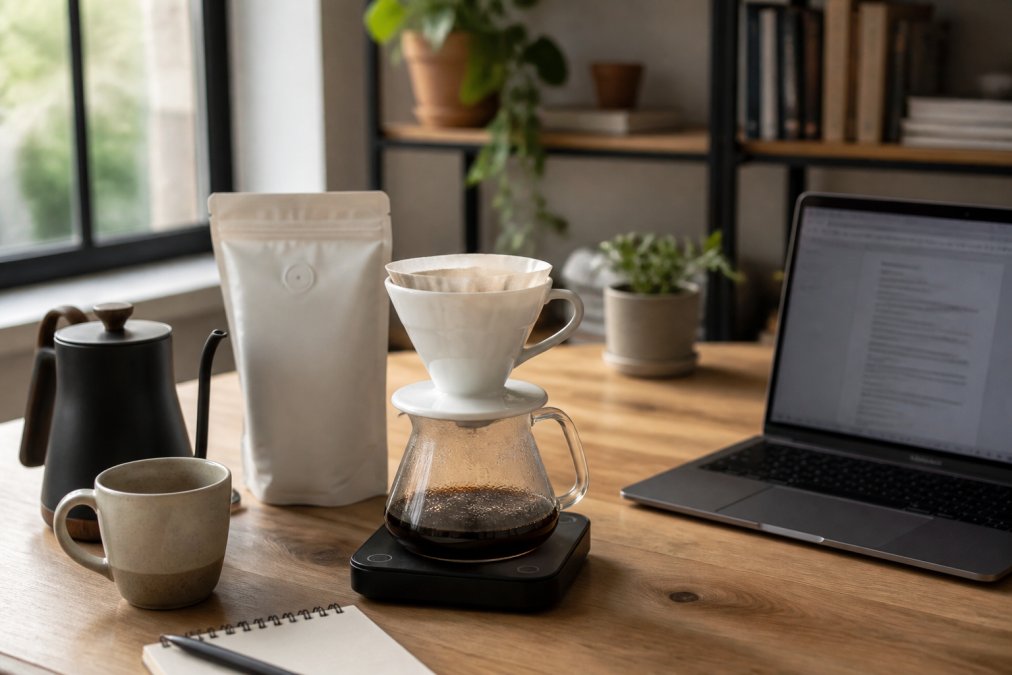
Medium roast suits most drip and pour-over setups. It keeps acidity and body in balance, so it works black or with milk. The Breakfast Blend and Peru Single Origin in the Best Sellers Sample Pack sit here.
Dark roast delivers bold, low-acid cups that stand up to milk and cream. The 6 Bean Blend and Cowboy Blend lean this way, with cocoa and caramel tones.
Light roast preserves more origin character and caffeine, though it can taste sharp to drinkers used to darker profiles. Ethiopia and Tanzania in the Single Origin Favorites Sample Pack show this clearly, with fruity and floral notes.
Flavored coffee works well for afternoon cups when you want something sweeter without added sugar. The Flavored Coffees Sample Pack covers French Vanilla, Hazelnut, and more.
Sample Packs: Try Before You Commit
Sample packs solve the biggest home office coffee problem: committing to a full bag you might not like. The Best Sellers Sample Pack ($24.99) includes six 2 oz packs across blends and single origins, enough for several cups each.
For origin explorers, the Single Origin Favorites Sample Pack ($24.99) spans Brazil, Colombia, Costa Rica, Ethiopia, Honduras, and Tanzania. If flavored coffee is your thing, the Flavored Coffees Sample Pack ($24.99) covers six profiles.
Bundles and Bulk Orders for Consistent Supply
The Best Seller Bundle ($61.99) brings together three 12 oz whole bean roasts: Bali Blue, Italian Roast, and Colombia Single Origin. That's 36 oz total, enough for a month of daily brewing for one or two people.
Buying a bundle beats reordering single bags because you keep a consistent supply without gaps. For a small team, ordering two bundles covers a shared kitchen setup.
Subscription vs. One-Time Purchase for Home Office Coffee
Subscriptions make sense when you drink coffee daily and want a predictable delivery schedule. One-time purchases suit lighter drinkers, gift orders, or anyone testing a roast before committing. But for a home office, the decision usually comes down to three variables competitors rarely address: how fast you actually consume beans, whether you share the supply, and how much you value not thinking about reordering.
The cost math, in plain terms
A subscription's value isn't the discount, it's the cadence. Here's how to model it:
- Daily drinker (1-2 cups/day): roughly one 12 oz bag every two to three weeks, or about 18-24 bags per year.
- Two-person home office: roughly 36-48 bags per year, or the equivalent in 2 lb bags.
- Occasional drinker (3-4 cups/week): one 12 oz bag per month is plenty.
If a subscription ships more often than you drink, you end up with a backlog of aging beans, the opposite of the freshness you're paying for. If it ships less often, you run out mid-week and fall back on grocery-store coffee, which defeats the purpose.
When a subscription wins
- You drink at a consistent daily pace and don't want to track inventory.
- You want roast-to-order freshness on a schedule rather than hoping a warehouse rotated stock.
- You're splitting the cost with a partner or small team and want one predictable line item.
- You travel rarely, so a fixed cadence matches your actual usage.
When one-time purchases win
- Your consumption varies week to week (busy season, travel, holidays).
- You're still dialing in which roast you like and don't want to commit to a recurring SKU.
- You want to stock up before a busy stretch and then coast for a month.
- You're buying for a shared office where different people have different preferences.
A hybrid approach that fits most home offices
Track how long your first bundle lasts, then set your reorder cadence to that number minus a few days of buffer.
Caffeine consistency for productivity
A less obvious factor: a recurring order of the same roast gives you a repeatable cup, which can help with focus.
At MineYourBusinessCoffee, orders are roasted to order, so freshness doesn't depend on warehouse turnover. The Founders Club loyalty program adds a lifetime discount and free shipping for members who want ongoing supply, which effectively turns a subscription into a lower per-bag cost for daily drinkers.
Equipment Pairing: Match Beans to Your Home Office Brewer
Matching beans to your brewer prevents the most common home office coffee complaint: coffee that tastes off despite good beans. Here's the pairing logic.
Brewer |
Grind Size |
Best Roast |
Why It Works |
|---|---|---|---|
Drip machine |
Medium |
Medium |
Even extraction, balanced cup |
Pour-over |
Medium-fine |
Light to medium |
Highlights acidity and flavor notes |
French press |
Coarse |
Medium-dark |
Builds body and mouthfeel |
Espresso |
Fine |
Dark or blend |
Handles pressure, cuts through milk |
Clean equipment matters as much as pairing. Coffee oils and mineral scale build up inside machines over time, and that residue makes even fresh beans taste bitter. The Coffee Maker Cleaner and Descaler Tablets ($19.99) cover up to a year of monthly cleaning, and they work with single-cup, drip, and espresso machines.
For hard water areas, citric acid descaler ($23.99) dissolves limescale from kettles and machines that run on water. A clean machine pulls full flavor from every bean.
Frequently Asked Questions
What are the best coffee beans for the office?
The best coffee beans for home office use balance freshness, flavor, and convenience. Medium roasts like Breakfast Blend work well for drip makers, while dark roasts such as Italian Roast suit espresso. Sample packs from MineYourBusinessCoffee start at $24.99 and let you test six options before committing. Look for whole bean, freshly roasted coffee with a clear roast date to ensure quality.
Should I choose single-origin or blends for my home office?
Single-origin coffees highlight distinct regional flavors, like the chocolate and cinnamon notes in Mexico Single Origin. Blends combine beans for consistent, balanced cups, such as the 6 Bean Blend. For home office coffee, blends offer reliability for daily brewing, while single-origins provide variety. A sample pack containing both helps you decide which suits your routine.
How does fresh-roasted coffee impact workplace productivity?
Fresh-roasted coffee tastes better because it retains more aromatic compounds and oils. When coffee is stale, it loses flavor and can taste bitter, which discourages breaks. Choosing freshly roasted beans from MineYourBusinessCoffee ensures each pot delivers consistent quality.
How do I store coffee beans for freshness in a home office?
Store whole beans in an airtight container away from light, heat, and moisture. A cool cupboard works better than a countertop near appliances. Avoid the refrigerator because condensation harms beans. Buy in quantities you will use within two to three weeks. For home office coffee, a 12 oz bag like the Best Seller Bundle ($61.99 for three bags) provides enough for regular brewing without long storage.
What is the 15-15-15 rule for coffee?
The 15-15-15 rule is a simple freshness guideline: Green coffee beans are best used within about 15 months. Roasted coffee is best enjoyed within about 15 days of roasting for peak flavor. Ground coffee is best brewed within about 15 minutes of grinding. Buying fresh-roasted coffee is the first step in benefitting from the 15-15-15 rule.