

How to Tell If Coffee Is Fresh Roasted: 7 Key Signs
Table of Contents
- Why Freshness Matters: Aroma, CO2, and the Science of Degassing
- Coffee Roast Date vs Expiration Date: Which One Actually Tells You Something
- Visual Inspection: Glossy vs Matte Beans and Oil Migration
- The Coffee Bloom Test: A Simple Home Method for Checking Freshness
- How Long Does Coffee Stay Fresh After Opening?
- Taste and Smell: Sensory Indicators of Fresh Roasted Coffee
- Packaging and Degassing Timeline: What Your Bag Reveals About Fresh Roasted Coffee
- Conclusion
- Frequently Asked Questions
Last Updated: September 13, 2026
Why Freshness Matters: Aroma, CO2, and the Science of Degassing
Learning how to tell if coffee is fresh roasted starts with understanding what happens inside the bean after it leaves the roaster. Freshly roasted coffee is still alive in a chemical sense: it releases carbon dioxide for days after roasting, and that degassing process is the single best signal of freshness you can measure at home.
When beans rest, CO2 escapes slowly. Some of it traps aroma compounds inside the bean, which is why a bag opened too early smells flat while the same coffee a week later smells sweet and layered. Roasters time their packaging around this window. A bag with a one-way valve lets carbon dioxide out without letting oxygen in, and oxygen is the real enemy: it drives oxidation, the process that turns bright acidity into papery, cardboard-like flavors.
That explains the paradox most drinkers run into. A bag stamped months ago can still taste decent if it was sealed well, while a "fresh" bag from an open bin can taste stale within days.
Coffee Roast Date vs Expiration Date: Which One Actually Tells You Something
The roast date is the only date that tells you anything useful about flavor. An expiration or best-by date is typically set by the retailer for stock rotation and food-safety compliance, not by how the coffee actually tastes, which means a bag can carry a comfortable "best by" window and still be well past its flavor peak.
Here is how the common labels compare in practice:
| Label | What It Measures | How Useful It Is |
|---|---|---|
| Roast date | When the beans finished roasting | High: direct freshness signal |
| Best-by date | Retailer's rotation window | Low: often months after roasting |
| Expiration date | Food-safety compliance | Minimal for flavor |
| Lot or batch code | Production run | Moderate: helps trace roast timing |
| "Packed on" date | When beans were bagged | Moderate: only useful if paired with roast date |
Why Best-By Dates Drift So Far From Flavor Peak
The gap exists because the two dates answer different questions. A best-by date is a food-safety and liability calculation: it assumes worst-case storage and sets a conservative outer bound. Flavor peak is a chemistry question tied to degassing and oxidation, and it arrives far earlier, often within two to four weeks of roasting for whole beans, depending on roast level and packaging (peer-reviewed research).
That is why a bag stamped six months out can taste flat on day ten. The date is not lying; it is answering a question you did not ask.
How to Read Ambiguous Labels
Not every bag prints a clean roast date. Watch for these patterns:
- Month-and-year only ("Best by 06/2027"): usually a twelve-month window from roast, so subtract backward to estimate. Treat the estimate as a ceiling, not a target.
- Julian or batch codes ("L2247"): the trailing digits often encode the day of year. Ask the roaster to decode rather than guessing.
- "Roasted for" or "Packed on": packing is not roasting. A coffee can sit in a warehouse for weeks before packing.
- No date at all: treat it as a sign the roaster would rather you not know, and ask before buying.
A Practical Buying Rule
If a bag shows only a best-by month, assume the roast date is roughly twelve months earlier and price your expectations accordingly. If it shows a roast date, buy the freshest one on the shelf and plan to finish it within two to three weeks of opening. For anyone serious about how to tell if coffee is fresh roasted, the roast date is the first thing to check and the last thing to compromise on.
Visual Inspection: Glossy vs Matte Beans and Oil Migration
Glossy beans are not automatically fresher, and this is where most guides get it backwards. A shiny, oily surface usually means one of two things: the coffee is a dark roast, where roasting heat has pushed oils to the surface, or the beans have been sitting long enough for oil migration to occur as internal oils work their way out.
A matte, dry-looking surface on a light or medium roast is generally the better sign. Oil migration is a slow process, so a medium roast that already looks wet and slick has often been off the roaster for a while. Dark roasts complicate the picture because they start glossy by design.
Look for these visual cues instead:
- Uneven color across beans, which suggests a stale or poorly stored batch
- A dull, dusty surface rather than a clean matte finish
- Visible oil sheen on a light roast specifically, which points to age
- Cracks or a hollow appearance in the bean's center line
Bean surface tells you part of the story. Grind consistency and aroma tell you the rest, which is why a visual check alone is never conclusive.
The Coffee Bloom Test: A Simple Home Method for Checking Freshness
The coffee bloom test is the fastest home method for checking freshness, and it takes about thirty seconds. When hot water hits fresh grounds, trapped carbon dioxide escapes rapidly, creating a thick, bubbling dome of foam. That reaction is the bloom, and its size tells you how much gas is still in the bean.
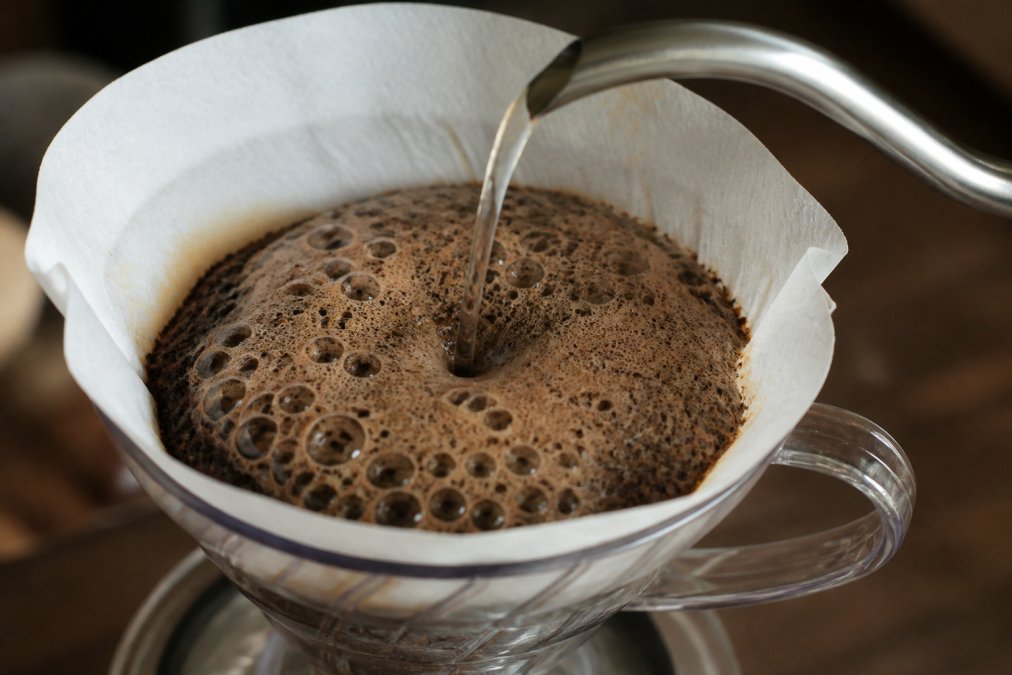
Here is how to run the test:
- Heat water to just off a boil, around 200°F (sca.coffee).
- Add two tablespoons of grounds to a pour-over cone or a mug.
- Pour a small amount of water over the grounds and stop.
- Watch for ten to fifteen seconds. Fresh coffee swells and bubbles vigorously.
- Note the result. A flat, quiet bed of grounds with little movement points to stale coffee.
A lively bloom is a strong freshness signal, but it is not the whole answer. Dark roasts degas faster than light roasts, so a dark roast can bloom modestly while still being fresh. A light roast that barely reacts is the clearer warning sign.
How Long Does Coffee Stay Fresh After Opening?
Coffee stays fresh for roughly one to two weeks after opening when stored in an airtight container away from light, heat, and moisture (peer-reviewed research). Whole beans hold their flavor longer than pre-ground coffee because the surface area exposed to oxygen is far smaller.
The clock starts the moment the bag is opened, not the moment it was roasted. Once oxygen reaches the beans, oxidation begins and accelerates with every exposure. A few practical habits extend that window considerably:
- Store beans in an opaque, airtight container, not the original bag's folded top
- Keep the container in a cool cupboard, never above the coffee maker or in the fridge
- Grind immediately before brewing to limit exposure
- Buy in quantities you will finish within two to three weeks
Freezing works if you do it properly: seal beans in an airtight container, freeze once, and never thaw and refreeze. Moisture and temperature swings do more damage than the freezer itself.
Taste and Smell: Sensory Indicators of Fresh Roasted Coffee
Your nose and palate catch what labels hide. Fresh roasted coffee smells sweet, complex, and slightly sharp, with the specific notes the roaster intended: fruit, chocolate, caramel, or floral depending on origin. Stale coffee loses those top notes first and settles into a flat, musty, or papery smell that no brewing method can fix.
Taste follows the same pattern. Fresh coffee has clear acidity and body, with flavors that shift as the cup cools. Stale coffee tastes hollow and dull, sometimes faintly rancid if the oils have oxidized badly. Bitterness without any sweetness underneath is another warning sign, though that can also come from over-extraction rather than age.
A useful test: brew the same coffee two ways, once as a pour-over and once in a French press. If both taste flat, the beans are the problem. If only one tastes off, your brewing method or equipment is the likely culprit.
Packaging and Degassing Timeline: What Your Bag Reveals About Fresh Roasted Coffee
Packaging technology decides how much of the roast's potential reaches your cup, and it is the one freshness signal you can evaluate before spending a dollar. Most guides skip this entirely, which is why it is worth slowing down here.

How a One-Way Valve Actually Works
A one-way valve is a small silicone or plastic membrane built into the bag. Internal pressure from escaping carbon dioxide pushes the membrane open, venting gas out. When external pressure exceeds internal pressure, which happens as the bag cools or as degassing slows, the membrane seals shut and blocks oxygen from entering. The result: beans can be sealed immediately after roasting without the bag inflating on the shelf or going stale from trapped oxygen.
A bag with a valve is not automatically fresh, but a bag without one is a warning sign. Standard sealed bags either trap CO2 (causing inflation and pressure buildup) or are packed after degassing, which means the coffee sat exposed to oxygen for days before sealing.
Degassing Timelines by Roast Profile
This is the part most articles flatten into a single number. Degassing speed depends heavily on roast level, because darker roasts develop more internal pressure and more porous cell structure during roasting.
- Light roasts: slower degassing, often peaking seven to fourteen days after roast. They can taste underdeveloped or "tight" in the first few days and improve noticeably through week two.
- Medium roasts: the middle ground, typically peaking four to ten days after roast. This is the window most roasters design their packaging and shipping around.
- Dark roasts: fast degassing, often peaking two to five days after roast. They can taste flat or ashy if brewed too soon, then fade faster once opened.
That difference matters when you judge a bag by its roast date alone. A dark roast at day ten may already be past peak, while a light roast at day ten may just be hitting its stride.
The Baggie Test: Measuring CO2 Release at Home
You do not need lab equipment to check whether a coffee is still degassing. Seal a small amount of freshly ground coffee in a zipper bag, press out most of the air, and watch it over thirty to sixty minutes. Fresh coffee will visibly puff the bag as CO2 releases. Coffee that barely expands has largely finished degassing.
Run the test on the same coffee at two points, once when you open the bag and once a week later, to see how the curve flattens. A bag that stops puffing entirely is a bag that has given up most of its gas, and usually most of its aroma with it.
What the Bag Tells You Before You Open It
- Valve present, bag slightly firm: actively degassing, likely fresh.
- Valve present, bag soft and slack: degassing has slowed, which can mean fresh-but-rested or simply old.
- No valve, bag inflated: CO2 is trapped, which can stale the coffee from the inside.
- No valve, bag vacuum-sealed: often packed after degassing, so freshness depends entirely on the roast date.
Conclusion
Judging freshness takes more than one glance at a label. The roast date, the bean's surface, the bloom, the smell, and the packaging all feed into a single answer, and the coffee that passes every check is the coffee worth brewing.
Frequently Asked Questions
Is coffee roasted 4 months ago still good?
Coffee roasted four months ago is generally past its peak. Most fresh roasted coffee tastes best within 2 to 6 weeks of the roast date, depending on the roast level. After four months, the beans have lost most of their carbon dioxide and aromatic oils, so you may notice flat or papery flavors. It is usually safe to drink but won't deliver the lively cup you expect from fresh coffee.
How can you tell if coffee beans have gone bad?
Look for a matte, dull surface with no sheen, a weak or absent bloom when you brew, and a stale, musty, or papery smell. If the beans feel dry and brittle and produce very little foam when hot water hits them, they are likely past their prime. Taste is the final check: bad beans yield a flat, hollow cup with no acidity or body.
How long after roasting should you wait to brew coffee?
Wait 3 to 7 days after the roast date for most coffees. During this degassing period, beans release carbon dioxide, which can interfere with extraction and create uneven flavor. Light roasts may need 5 to 10 days, while dark roasts are often ready in 2 to 4 days. Brewing too soon can make the coffee taste sharp or underdeveloped.
What are the physical signs of fresh roasted coffee beans?
Fresh beans have a slightly glossy or satin surface (especially dark roasts), feel plump and heavy for their size, and release a strong, complex aroma when you open the bag. When you press a bean, it should feel firm rather than brittle. If the beans look uniformly matte, feel lightweight, or smell faint, they are likely older than ideal.
Buying coffee that was roasted days ago, not months ago, removes most of the guesswork. MineYourBusinessCoffee roasts each order fresh, offers a range of single origins, blends, and flavored coffees, and lets you add custom labels for gifts, events, or your own daily motivation. The Founders Club adds free shipping and a lifetime discount for members who order regularly. Get started with MineYourBusinessCoffee and taste what a genuinely fresh roast does for your morning.